|
|

|
|
|
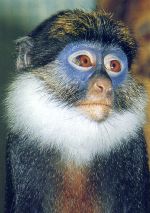
Animal Info - Red-bellied Monkey(Other Names: Cercopithèque à Ventre Roux, Nigerian Guenon, Nigerian White-throat Monkey, Red-bellied Guenon, Rotbauchmeerkatze, White-throated Guenon or Monkey)Cercopithecus erythrogasterStatus: EndangeredContents1. Profile (Picture) ProfilePictures: Red-bellied Monkey #1 (10 Kb JPEG); Red-bellied Monkey #2 (166 Kb GIF) (Prim. Info Net) The red-bellied monkey weighs 2 - 4.5 kg (4.4 - 9.9 lb). It is arboreal, living in moist tropical forest and the
wettest parts of dry tropical forest. It is also found in secondary bush and old farmland.
Its diet includes fruit, insects, leaves and crops. Solitary males have been observed, but
usually the red-bellied monkey forages in small groups of up to 5 individuals, although
groups of 30 or more probably occur (Oates 1985). Tidbits*** The red-bellied monkey does not adapt well to highly degraded forest. Status and TrendsIUCN Status:
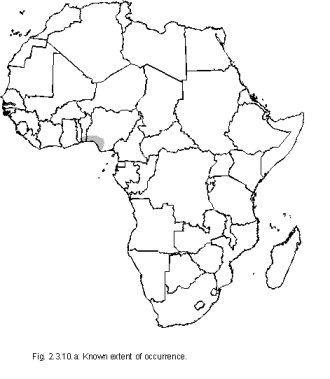
Countries Where the Red-bellied Monkey Is Currently Found:2004: Occurs in Nigeria and Benin. May occur in Togo. (IUCN 2004) History of Distribution:The red-bellied monkey occurs in southwestern Nigeria and southern Benin. It may occur in Togo. (IUCN 2004) Distribution Map (14 Kb GIF) (African Mammals Databank 2004) Threats and Reasons for Decline:Threats include hunting and habitat degradation from agriculture and logging Data on Biology and EcologyWeight:
Habitat:
Diet:
Behavior:
Social Organization:
Density and Range:
ReferencesAfrican Mammals Databank 2004, Burton & Pearson 1987, Cons. Intl. 2005, IUCN 1994, IUCN 1996, IUCN 2000, IUCN 2003a, IUCN 2004, Kingdon 1997, Macdonald 1984, Oates 1985, Oates 1996, Prim. Info Net Top of Page | Search This Site Home | Rarest Mammals | Species Index | Species Groups Index | Country Index | Links Last modified: June 4, 2005; |
|
© 1999 - 2019
Animal
Info. Endangered animals of the
world.
Contact Us.. |